
30 Small Kitchen Hacks for Homes Without a Pantry

You don’t need to buy a full matching set on day one — that gets expensive. Start with a few containers for your highest-volume staples: flour, sugar, rice, pasta, rolled oats, coffee. Measure your shelf height first and buy containers that fit without wasting too much headroom. Airtight containers keep food fresh longer, which is an added bonus.
Square and rectangular containers use space more efficiently than round ones — they pack together without gaps. Wide-mouth containers are easier to scoop from than narrow ones.
Extra Tips
Write the expiration date from the original package on a small piece of masking tape and stick it to the bottom of the container. You won’t lose track of freshness even after the bag is gone.
What to Avoid
Don’t decant everything all at once before you know what sizes you need. Buy a few containers, test them, then gradually expand the system. Buying 20 containers in the wrong size wastes money.
17.Label Everything Clearly
The Problem
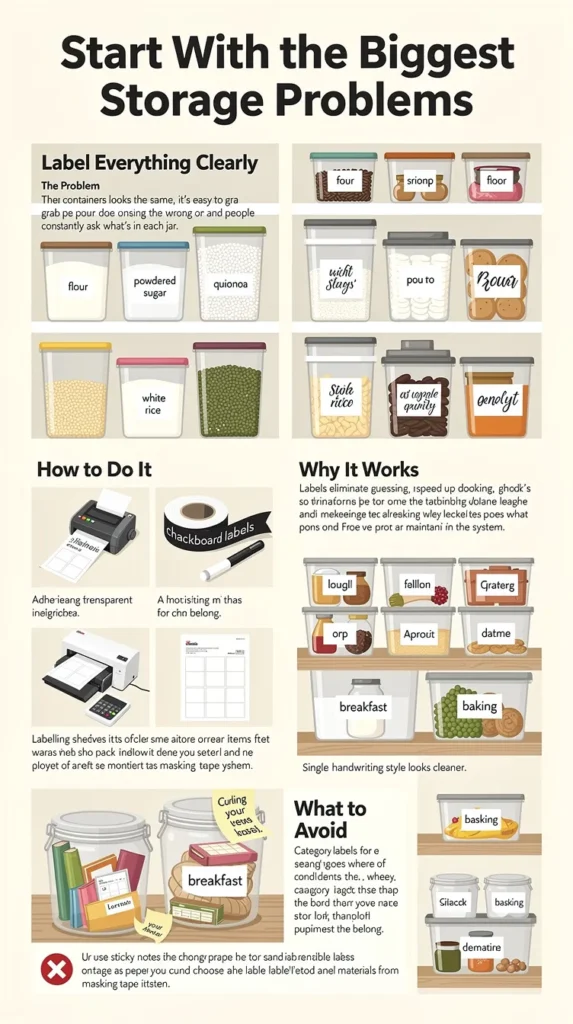
When containers all look the same, it’s easy to open the wrong one — especially for similar-looking items like flour and powdered sugar, or white rice and quinoa. If you live with others, unlabeled containers mean constant questions about what’s in each jar.
© 2025 AI Illustrator — Inspiration Only
Why It Works
Labels turn a visually consistent storage system into a functional one. They eliminate guessing, speed up cooking, and help everyone in the household maintain the system. They also make it immediately obvious when something is running low or when a container is empty and needs replacing.
How to Do It
Labels don’t need to be fancy. A labelmaker is convenient, but a roll of chalkboard labels and a chalk marker works just as well and looks appealing. You can also use adhesive labels with a permanent marker, or even adhesive transparent labels printed on a home printer.
Label both the container and the shelf or bin where it lives. This is the key step most people skip — labeling only the container means you have to pick it up and read it. Labeling the shelf means you can see what goes where from across the kitchen.
Extra Tips
If you use chalkboard labels, commit to a single handwriting style — it looks cleaner than a mix of label types and scripts. For bins with multiple items, a category label on the front of the bin (“breakfast,” “baking,” “snacks”) is more useful than labeling every individual item inside.
What to Avoid
Don’t use sticky notes as labels — they fall off, look messy, and can accidentally end up stuck to the wrong container. Invest in proper label material even if it’s just a basic roll of masking tape.
One Comment
Comments are closed.